
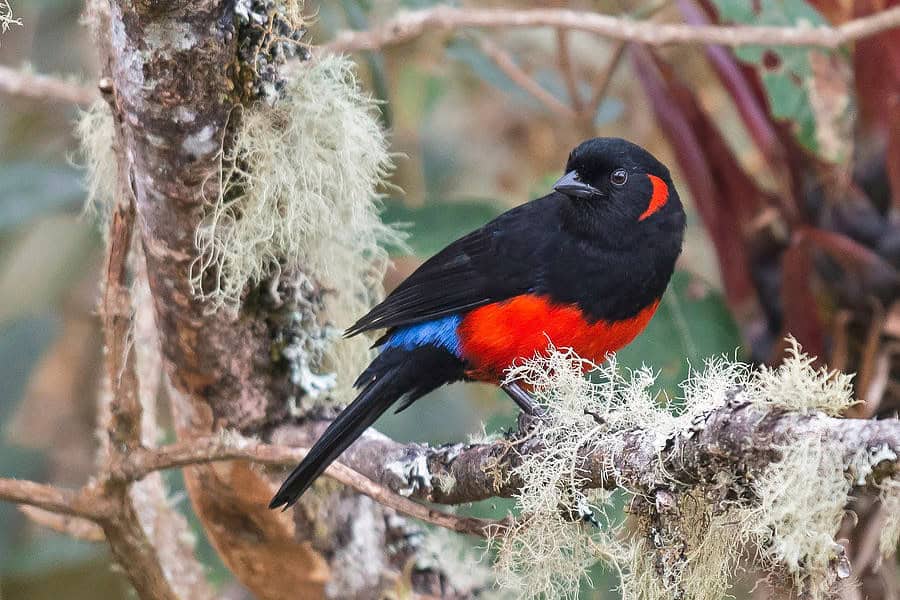
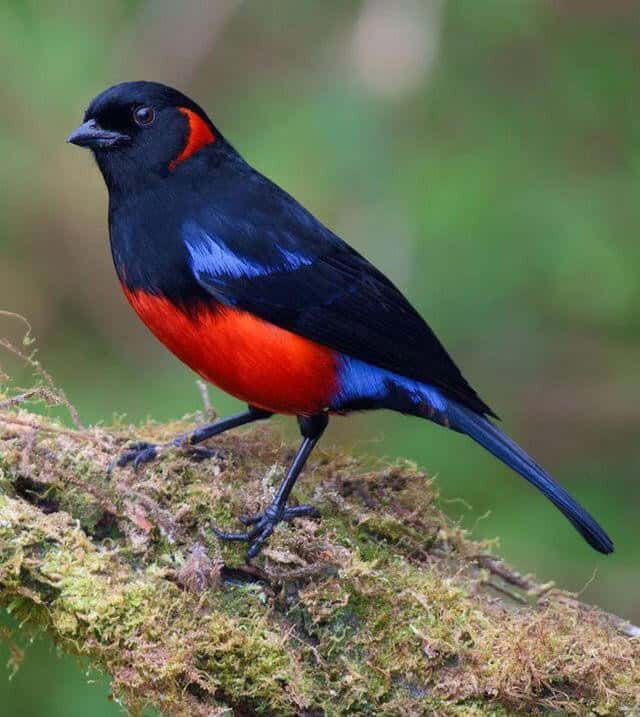
Perched high in the cloud forests of the Andes, the Scarlet-bellied Mountain Tanager (Anisognathus igniventris) dazzles with its colorful appearance and lively behavior. This bright, eye-catching bird, native to the highlands of South America, represents the rich biodiversity of its unique environment.
With a scarlet belly that stands out against its deep blue head and back, the Scarlet-bellied Mountain Tanager is a striking sight. Its black and white wing markings add to its beauty, making it a vivid contrast against the misty mountain landscape.

This species is native to the cloud forests stretching from Venezuela to Bolivia, where the cool and moist conditions provide the perfect setting for its survival. Here, the tanager plays a vital role in its ecosystem by spreading seeds and helping control insect populations, supporting the delicate balance of the forest.
However, the Scarlet-bellied Mountain Tanager faces serious threats. Deforestation, agriculture, and mining have led to habitat loss, fragmenting its population and limiting its resources. The effects of climate change, including shifts in temperature and rainfall, are adding to the strain on this fragile environment.

Conservation efforts are in place to protect the Scarlet-bellied Mountain Tanager and its habitat. Protected areas, reforestation programs, and collaboration with local communities aim to safeguard both the species and the wider ecosystem.
Ecotourism initiatives also help by promoting sustainable practices that benefit local economies while raising awareness about the need to preserve these forests.

For birdwatchers, spotting the Scarlet-bellied Mountain Tanager in its natural habitat is a special experience. Its songs echo through the valleys, offering a glimpse into the complex, interdependent world of the Andean cloud forest.
Protecting species like the Scarlet-bellied Mountain Tanager is essential to preserving the diversity of life in the Andes and beyond. By safeguarding their habitats, we contribute to ecosystems’ resilience and our planet’s overall health.
Read More Birds
