
Two foreign tourists have been convicted after disturbing nesting sea turtles at Oman’s Ras Al Hadd Turtle Reserve and publishing video of their actions online.
The Court of First Instance in Sur found the pair guilty after investigators determined that they touched and approached nesting turtles, climbed onto the backs of large turtles, and handled smaller turtles inside the protected reserve. The case moved beyond the initial announcement of “legal action”: by October 5, 2026, Omani authorities had confirmed the convictions and sentences.
What the court ordered
Oman’s Public Prosecution said each defendant was fined OMR 100 for the wildlife offence. The court also imposed a one-month prison sentence connected to producing and publishing content deemed prejudicial to public order through information technology. The custodial sentence was suspended, the penalties were merged, and the judgment was ordered to be published.
Early reports identified the case only as an Environment Authority investigation. The later court result is important because it confirms that the conduct led to convictions rather than merely a warning or an unresolved inquiry.
Why nesting turtles need distance
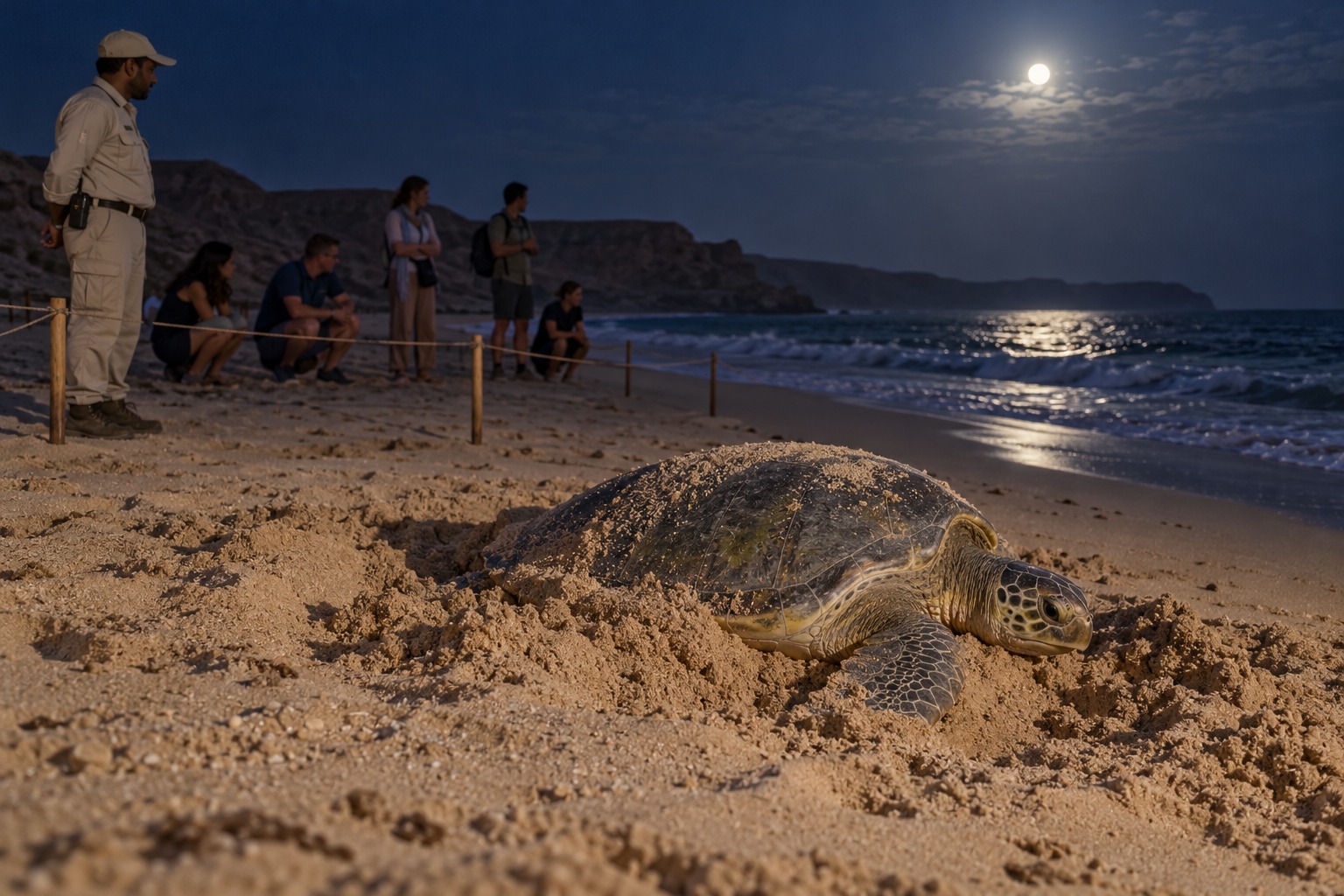
Nesting is a vulnerable stage in a sea turtle’s life cycle. A female must leave the water, cross the beach, select a nesting site, dig a chamber, lay her eggs and return to the sea. Touching, crowding or climbing onto a turtle can interrupt that process and cause unnecessary stress.
Oman’s Environment Authority tells visitors not to touch, approach or disturb nesting turtles. Official reserve guidance also prohibits disturbing turtle nests, touching or moving eggs, and collecting wildlife.

A major nesting landscape
Ras Al Hadd forms part of one of Oman’s most important turtle-nesting landscapes. The reserve was established by royal decree in 1996 and includes roughly 45 kilometres of coastline. Environment Authority reporting published in June 2026 said the reserve received approximately 60,000 nesting green turtles during the previous season.
Those figures explain why careful visitor management matters. Even when people intend only to take photographs or videos, close physical contact can turn wildlife tourism into direct interference with protected animals.
How visitors can protect turtles
People visiting nesting beaches should follow reserve staff instructions, remain behind designated boundaries, keep noise and lights low, avoid flash photography, and never touch adults, hatchlings, nests or eggs. A photograph is never more important than an animal’s safety.
The court case sends a clear message: protected wildlife is not a prop for social-media content. Responsible observation means giving turtles the distance and quiet they need to complete a journey that has continued for generations.
Sources
- Times of Oman: court convictions and penalties
- Oman Observer: Public Prosecution statement and court outcome
- Oman Environment Authority: Ras Al Hadd nesting statistics
